Laylat al-Qadr in the Quran: What the Night of Decree Is and When to Seek It
Laylat al-Qadr, the Night of Decree, is the night in which the Quran was sent down, and the Quran says it is better than a thousand months.
Last updated:
Laylat al-Qadr is also called the Night of Power or the Night of Destiny. It comes once a year, in the month of Ramadan. Muslims spend it in prayer, hoping for forgiveness and mercy.
The Quran gives this night its own surah, but it does not say which night it is. This article sets out what the Quran says, what the Prophet ﷺ taught, and what scholars have said about the date.
Four things to know
What the Quran says
Surah Al-Qadr and the other verses about the blessed night.
What the name means
Why it is called the Night of Decree.
When it is
What the hadith and the scholars say about the date.
How to spend it
The Prophet’s ﷺ practice and the prayer he taught Aisha.
What Does the Quran Say?
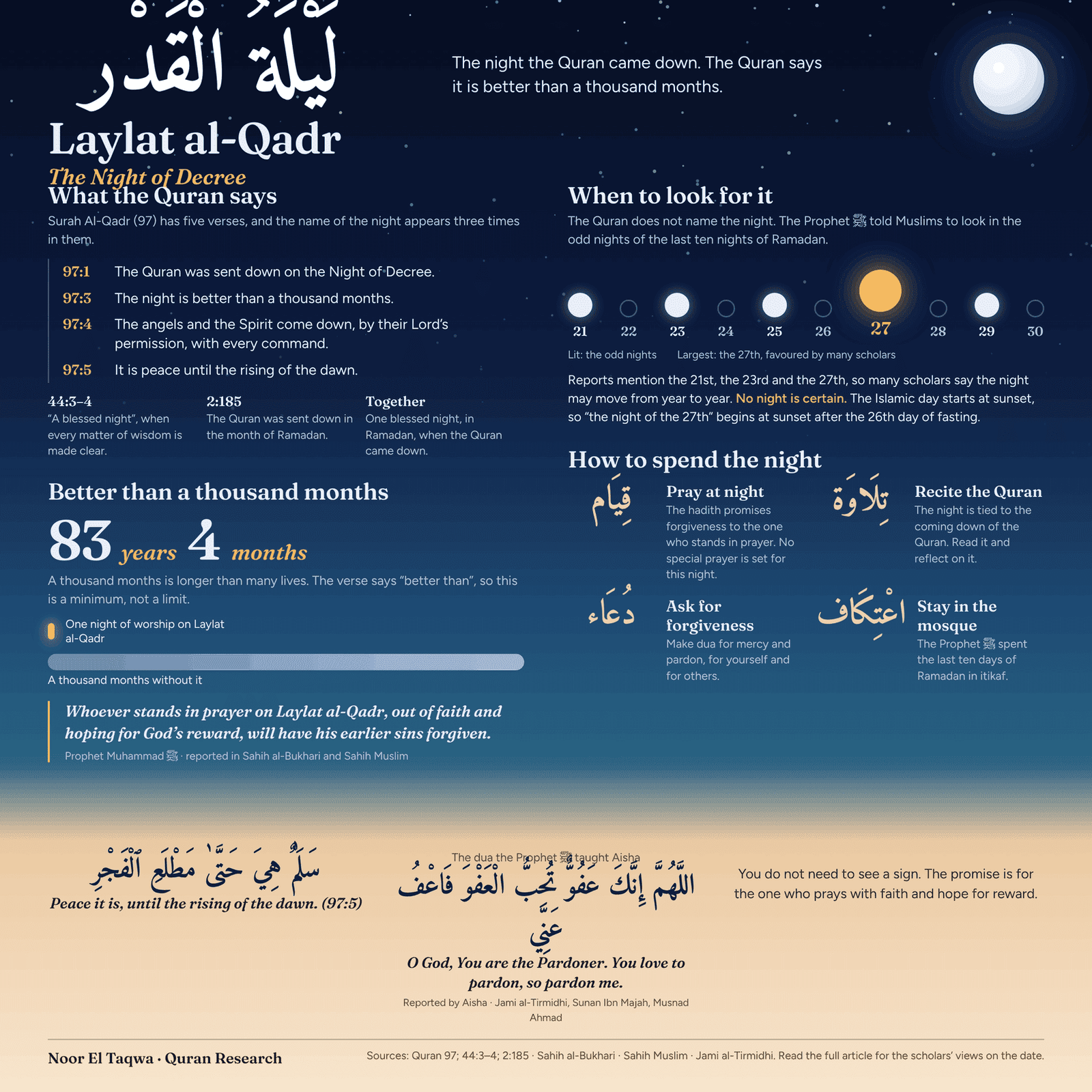
The night has its own chapter, Surah Al-Qadr (“The Decree”). It has five verses, and the words “the Night of Decree” appear three times in them.
إِنَّآ أَنزَلۡنَٰهُ فِي لَيۡلَةِ ٱلۡقَدۡرِ وَمَآ أَدۡرَىٰكَ مَا لَيۡلَةُ ٱلۡقَدۡرِ لَيۡلَةُ ٱلۡقَدۡرِ خَيۡرٞ مِّنۡ أَلۡفِ شَهۡرٖ تَنَزَّلُ ٱلۡمَلَـٰٓئِكَةُ وَٱلرُّوحُ فِيهَا بِإِذۡنِ رَبِّهِم مِّن كُلِّ أَمۡرٖ سَلَٰمٌ هِيَ حَتَّىٰ مَطۡلَعِ ٱلۡفَجۡرِ
We sent it down on the Night of Decree. And what will make you know what the Night of Decree is? The Night of Decree is better than a thousand months. The angels and the Spirit come down in it, by the permission of their Lord, with every command. It is peace until the rising of the dawn.
Meaning of the surah in simple English
- “We sent it down.” The “it” is the Quran. The surah does not say the word, because it is well known. Commentators take this as a sign of the Quran’s greatness.
- “Better than a thousand months.” Worship on this night is worth more than worship in a thousand months without it.
- “The angels and the Spirit come down.” The night is a time of heavenly presence and mercy.
- “Peace until dawn.” The whole night, from sunset to the first light, is a night of peace.
Two other places that point to the same night
- Surah Ad-Dukhan (44:3–4)God says He sent the Quran down “on a blessed night”, and that in it every matter of wisdom is made clear. Most commentators say this is Laylat al-Qadr. See Surah Ad-Dukhan.
- Surah Al-Baqarah (2:185)God says the Quran was sent down in the month of Ramadan. This tells us which month the night is in. See verse 2:185.
إِنَّآ أَنزَلۡنَٰهُ فِي لَيۡلَةٖ مُّبَٰرَكَةٍۚ إِنَّا كُنَّا مُنذِرِينَ فِيهَا يُفۡرَقُ كُلُّ أَمۡرٍ حَكِيمٍ
We sent it down on a blessed night. We were always giving warning. In it every matter of wisdom is made clear.
شَهۡرُ رَمَضَانَ ٱلَّذِيٓ أُنزِلَ فِيهِ ٱلۡقُرۡءَانُ هُدٗى لِّلنَّاسِ وَبَيِّنَٰتٖ مِّنَ ٱلۡهُدَىٰ وَٱلۡفُرۡقَانِ
The month of Ramadan is the month in which the Quran was sent down, as guidance for people, with clear proofs of guidance and the standard that separates right from wrong.
Put together, the three passages say this: the Quran came down on a blessed night, that night is Laylat al-Qadr, and it falls in Ramadan.
Why Is It Called the Night of Decree?
The Arabic word قَدْر (qadr) has more than one meaning. Commentators have given three main explanations for the name.
- DecreeOn this night the matters of the coming year are made clear and given to the angels to carry out (see 44:4). Many early commentators gave this explanation. See divine decree.
- HonourThe night has great rank and honour, and so does the person who spends it in worship.
- NarrownessSome say qadr here also carries the sense of “narrowed”, because so many angels come down that the earth is filled with them. This is a less common explanation.
In English the night is called the Night of Decree, the Night of Power or the Night of Destiny. These are different ways of translating the same word. Learn more on the concept page for the Night of Decree.
Better Than a Thousand Months
Verse 97:3 says the night is “better than a thousand months”. A thousand months is about 83 years and 4 months, which is longer than many people live.
Commentators explain that worship on this one night is better than worship in a thousand months that do not include it. The verse says “better than”, so it sets a minimum, not a limit.
Some books of commentary say the verse was a gift to the Prophet’s ﷺ community, whose lives are shorter than those of earlier nations. The reports that say this are weak in their chains, so scholars handle them with care. The verse does not depend on them.
The Prophet ﷺ also linked this night to forgiveness:
“Whoever stands in prayer on Laylat al-Qadr, out of faith and hoping for God’s reward, will have his earlier sins forgiven.”
Notice the two conditions: faith, and hoping for reward. The prayer must be done for God’s sake. See also forgiveness.
What Comes Down on the Night?
Verse 97:4 says that “the angels and the Spirit” come down in the night “by the permission of their Lord, with every command”.
- The angelsThey come down in great numbers. Read more about the angels in the Quran.
- The SpiritMost commentators say this is Jibril (Gabriel). He is named separately to show his high rank. Some commentators give other explanations of the Spirit.
- Every commandCommentators explain this as every matter God has decreed for the year, which the angels carry out by His permission.
- PeaceVerse 97:5 calls the night “peace”. Commentators describe it as a night of safety, mercy and calm.
The peace lasts “until the rising of the dawn”, so the whole night counts, from sunset until the first light of the morning.
When Is Laylat al-Qadr?
The Quran says the night is in Ramadan, but it does not give the date. The Prophet ﷺ also did not fix it. Here is what the hadith tell us.
Why was the date not told?
Ubadah ibn al-Samit reported that the Prophet ﷺ came out to tell the people which night it was. Two Muslims were arguing, and he said the knowledge of it was lifted. He added that this may be better for them, and told them to look for it on the ninth, the seventh and the fifth nights (Sahih al-Bukhari).
Scholars understand that what was lifted was the knowledge of the exact night, not the night itself. The Prophet ﷺ still told them to look for it.
What the hadith say
- The last ten nights. Aisha reported that the Prophet ﷺ said to look for it among the odd nights of the last ten nights of Ramadan (Bukhari, Muslim).
- The last seven nights. Ibn Umar reported that some Companions saw the night in their dreams in the last seven nights, and the Prophet ﷺ said their dreams agreed on that period (Bukhari, Muslim).
- The 21st. Abu Said al-Khudri reported that the Prophet ﷺ was shown the night, and saw himself prostrating in water and mud on its morning. Rain fell on the night of the 21st (Bukhari, Muslim).
- The 23rd. Abdullah ibn Unays reported a similar dream and said the rain fell on the night of the 23rd (Muslim).
- The 27th. Ubayy ibn Kab swore that it was the night of the 27th, and said the Prophet ﷺ had told them to look for it by a sign (Muslim).
These reports point to different nights. For this reason many scholars say the night may move among the odd nights from year to year, so that believers look for it in all of them.
What scholars have said
| View | Notes |
|---|---|
| The odd nights of the last ten | The most widely held view, based on the hadith above. |
| The 27th night | Favoured by many scholars. It rests on the report of Ubayy ibn Kab. |
| The 21st or the 23rd night | Supported by the reports of Abu Said al-Khudri and Abdullah ibn Unays. |
| It moves from year to year | Held by many scholars. It explains why the reports differ. |
| Shia tradition | The 19th, 21st and 23rd nights are commonly observed, and the 23rd is given the most weight. |
Ibn Hajar al-Asqalani, in his commentary on Sahih al-Bukhari, listed more than forty different opinions on the date. This shows that the question was open among scholars from early times.
Some commentators also point out that the word هِيَ (“it is”) in verse 5 is the 27th word of the surah, and they see a hint of the 27th night. This is an observation, not a proof. The Quran does not state the date.
A note on counting the nights
In the Islamic calendar the day begins at sunset. So “the night of the 27th” begins at sunset at the end of the 26th day of Ramadan, not the 27th. The night comes before the day with the same number.
Why is it hidden?
Scholars say there is wisdom in this. When the night is not fixed, believers pray and make dua on many nights, not on one night only.
How Did the Prophet ﷺ Spend These Nights?
Aisha said that when the last ten nights began, the Prophet ﷺ stayed awake at night, woke his family, and worked harder in worship (Bukhari, Muslim). She also said he stayed in the mosque for the last ten days of Ramadan until God took his soul (Bukhari, Muslim).
- Night prayerThe hadith above promises forgiveness to the one who stands in prayer on this night. See night prayer. The hadith does not set a special prayer or a fixed number of units for the night, so believers pray as they normally do at night.
- Reciting the QuranThe night is linked to the coming down of the Quran, so many people spend part of it reading and reflecting on the Quran.
- Dua and asking forgivenessThe night is a time to ask God for mercy and forgiveness. See supplication.
- Staying in the mosqueThis practice is called itikaf. The Prophet ﷺ did it in the last ten days of Ramadan. See spiritual retreat.
The prayer the Prophet ﷺ taught Aisha
Aisha asked the Prophet ﷺ what she should say if she found the night. He taught her this short dua:
اللَّهُمَّ إِنَّكَ عَفُوٌّ تُحِبُّ الْعَفْوَ فَاعْفُ عَنِّي
“O God, You are the Pardoner. You love to pardon, so pardon me.”
The word عَفُوّ (afuww) is one of God’s names. It means the One who erases sins completely. See the Pardoner.
Remember that the reward is promised to the one who prays with faith and hope, whether or not he notices anything unusual that night.
Common Questions
- Is it the night the Prophet ﷺ first received revelation?Many scholars say yes. The first verses (96:1–5) came to him in Ramadan, in the cave of Hira. Others explain that the whole Quran came down to the lowest heaven on this night, and was then sent to the Prophet ﷺ in parts over about 23 years. This second view is reported from Ibn Abbas. Both views are old, and some scholars hold them together. Either way, the Quran ties its coming down to this night.
- Is the “blessed night” in Surah 44 the middle of Shaban?A few early scholars said so. Most commentators, including Ibn Kathir, say it is Laylat al-Qadr, because Surah 97 and verse 2:185 place the coming down of the Quran on a night in Ramadan.
- Do I have to see a sign?No. The promise of forgiveness is for the one who prays out of faith and hope for reward. It does not depend on seeing anything. Ubayy ibn Kab reported one sign: the next morning the sun rises white, without strong rays. But this is seen after the night, and it is not a condition for the reward.
- Is it always the 27th?No. Many scholars favour the 27th, but the Prophet ﷺ did not fix the night, and the reports mention other nights. The safest way is to look for it in all the odd nights, and as much as you can in the other nights of the last ten.
- Is it the same as the Night Journey?No. The Night Journey, mentioned in Surah Al-Isra, is a different event. Read about it in Isra and Miraj. Laylat al-Qadr is the night the Quran came down, and it is in Ramadan.
Conclusion
Laylat al-Qadr is the night in which the Quran came down. The Quran calls it better than a thousand months, tells us that the angels and the Spirit come down in it, and calls it peace until dawn. It does not name the date, and the hadith point to the last ten nights of Ramadan, especially the odd nights.
The lesson is simple. God hid the exact night so that believers would try on many nights, pray with faith, ask for forgiveness, and stay close to the Quran. The dua the Prophet ﷺ taught Aisha is a good place to begin.
Sources and References
- The Holy Quran
- Surah Al-Qadr (97); Surah Ad-Dukhan (44:3–4); Surah Al-Baqarah (2:185); Surah Al-Alaq (96:1–5).
- Sahih al-Bukhari
- Reports on standing in prayer on the night, looking for it in the last ten nights, the dreams of the Companions, the report of Ubadah ibn al-Samit, and the Prophet’s ﷺ practice in the last ten nights.
- Sahih Muslim
- Reports of Ubayy ibn Kab, Abu Said al-Khudri and Abdullah ibn Unays.
- Jami al-Tirmidhi; Sunan Ibn Majah; Musnad Ahmad
- The dua that Aisha was taught.
- Tafsir al-Tabari, Tafsir Ibn Kathir and Tafsir al-Qurtubi
- Commentary on Surah 97 and Surah 44, and the meanings of the word qadr.
- Ibn Hajar al-Asqalani, Fath al-Bari
- Commentary on Sahih al-Bukhari, including the discussion of the date of the night.